CAterpillar: Designing the future
of electrified construction
CAterpillar: Designing the future
of electrified construction
Building an AI-powered Energy Management ecosystem to eliminate downtime for the world's first electric heavy machinery fleet.
Building an AI-powered Energy Management ecosystem to eliminate downtime for the world's first electric heavy machinery fleet.
ROLE
ROLE
Senior Product Designer (End-to-End).
Senior Product Designer (End-to-End).
TEAM
TEAM
2 PMs, 8 Engineers, Data Science Team.
2 PMs, 8 Engineers, Data Science Team.
FOCUS
FOCUS
0→1 Product Launch, Data Viz, Industrial AI.
0→1 Product Launch, Data Viz, Industrial AI.
The Gist
The Gist
Brief summary of the "Electrification" shift.
Brief summary of the "Electrification" shift.
SaaS
B2B
AI
Industrial / Energy
Overview
Pioneering the Electric Future of Heavy Machinery
Pioneering the Electric Future of Heavy Machinery
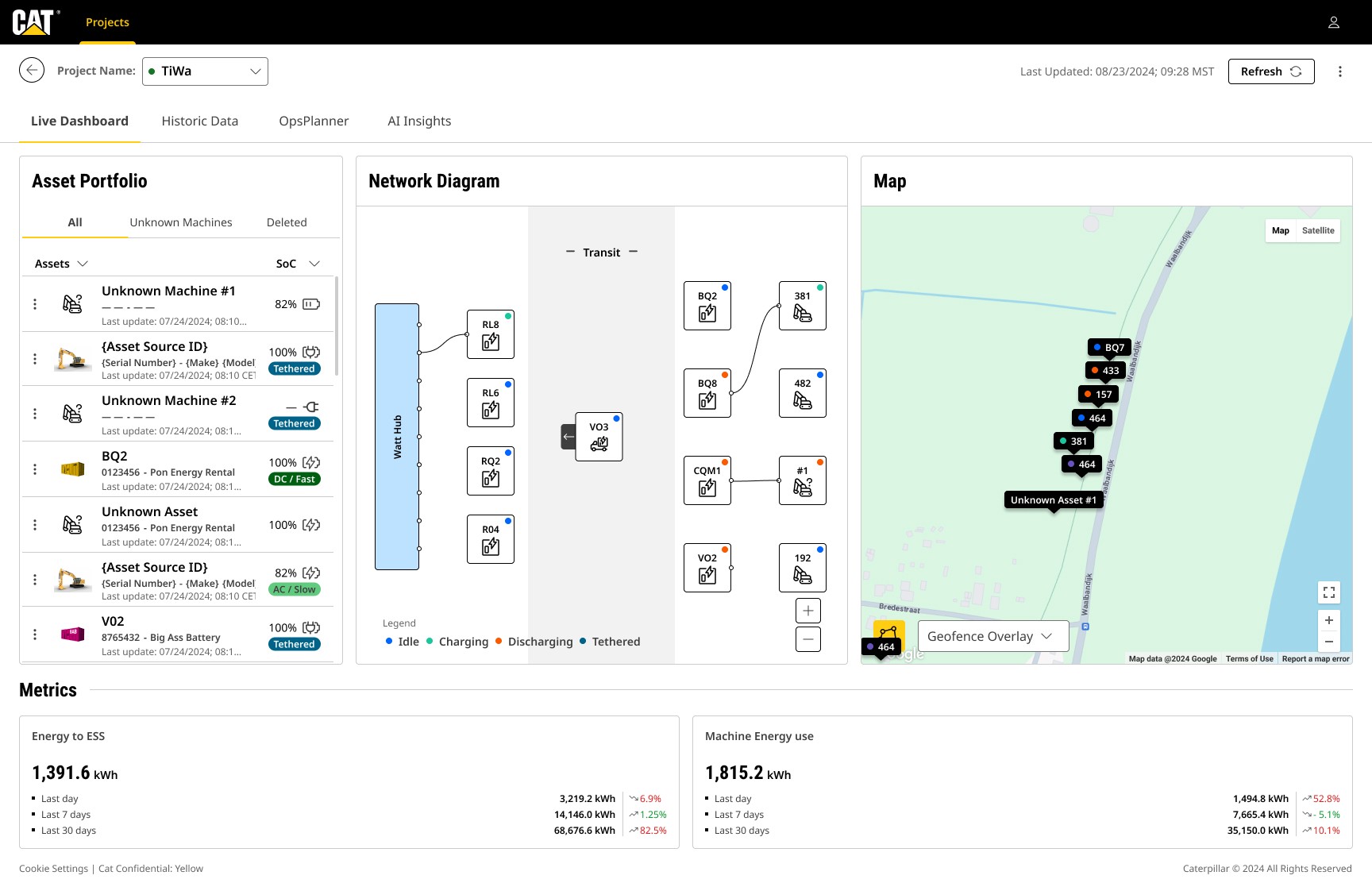
As Caterpillar transitions from legacy diesel engines to a zero-emission electric fleet, the operational complexity for construction sites has multiplied. I led the end-to-end design for eFlow, a mission-critical Energy Management ecosystem. This platform was built from the ground up to empower site managers to monitor, manage, and optimize energy consumption across their entire fleet in real-time. My role involved overseeing the product strategy, data visualization, and the integration of AI-native workflows to ensure that Caterpillar’s electrification efforts were not just sustainable, but more efficient than the traditional diesel model.
As Caterpillar transitions from legacy diesel engines to a zero-emission electric fleet, the operational complexity for construction sites has multiplied. I led the end-to-end design for eFlow, a mission-critical Energy Management ecosystem. This platform was built from the ground up to empower site managers to monitor, manage, and optimize energy consumption across their entire fleet in real-time. My role involved overseeing the product strategy, data visualization, and the integration of AI-native workflows to ensure that Caterpillar’s electrification efforts were not just sustainable, but more efficient than the traditional diesel model.
My Role:
My Role:
My role involved overseeing the product strategy, data visualization, and the integration of AI-native workflows to ensure that Caterpillar’s electrification efforts were not just sustainable, but more efficient than the traditional diesel model.
My role involved overseeing the product strategy, data visualization, and the integration of AI-native workflows to ensure that Caterpillar’s electrification efforts were not just sustainable, but more efficient than the traditional diesel model.

THE CHALLENGE
The Goal: Quantify the pain point. Why was this hard?
The Goal: Quantify the pain point. Why was this hard?
The Problem:
The Problem:
In the diesel world, refueling is simple. In the electric world, moving a 20-ton excavator to a charging station is a massive waste of time and energy. Caterpillar’s solution was to move the "fuel" to the machine using massive mobile Power Banks (MEC and ESS units).
In the diesel world, refueling is simple. In the electric world, moving a 20-ton excavator to a charging station is a massive waste of time and energy. Caterpillar’s solution was to move the "fuel" to the machine using massive mobile Power Banks (MEC and ESS units).
The Core Challenge:
The Core Challenge:
Operators had zero visibility into the energy state of their fleet. If an excavator ran out of battery mid-dig, or if a mobile Power Bank wasn't moved to the right spot at the right time, it resulted in multi-million dollar downtime. We needed to bridge the gap between "dumb" hardware and "intelligent" energy logistics.
Operators had zero visibility into the energy state of their fleet. If an excavator ran out of battery mid-dig, or if a mobile Power Bank wasn't moved to the right spot at the right time, it resulted in multi-million dollar downtime. We needed to bridge the gap between "dumb" hardware and "intelligent" energy logistics.
Problem Space:
No visibility. No control. No playbook.
No visibility. No control. No playbook.
Through stakeholder interviews and field research, I mapped out the core pain points facing construction site managers during the electrification transition.
Through stakeholder interviews and field research, I mapped out the core pain points facing construction site managers during the electrification transition.
The Problem:
The Problem:
Operators couldn't see real-time energy levels across MEC and ESS batteries, leading to unexpected machine shutdowns mid-task.
Operators couldn't see real-time energy levels across MEC and ESS batteries, leading to unexpected machine shutdowns mid-task.
Live battery monitoring
Live battery monitoring
Operators couldn't see real-time energy levels across MEC and ESS batteries, leading to unexpected machine shutdowns mid-task.
Operators couldn't see real-time energy levels across MEC and ESS batteries, leading to unexpected machine shutdowns mid-task.
No spatial awareness
No spatial awareness
Site managers had no way to see where electric equipment was located or navigate between machines across large construction sites.
Site managers had no way to see where electric equipment was located or navigate between machines across large construction sites.
Interactive map navigation
Interactive map navigation
Built a live map view with machine locations, status indicators, and click-to-detail navigation across the full fleet.
Built a live map view with machine locations, status indicators, and click-to-detail navigation across the full fleet.
No spatial awareness
No spatial awareness
Site managers had no way to see where electric equipment was located or navigate between machines across large construction sites.
Site managers had no way to see where electric equipment was located or navigate between machines across large construction sites.
Interactive map navigation
Interactive map navigation
Built a live map view with machine locations, status indicators, and click-to-detail navigation across the full fleet.
Built a live map view with machine locations, status indicators, and click-to-detail navigation across the full fleet.
Data overload, no insights
Data overload, no insights
Raw telemetry data was available but impossible for non-technical users to interpret or act on meaningfully.
Raw telemetry data was available but impossible for non-technical users to interpret or act on meaningfully.
AI-powered Insight (EFlow)
AI-powered Insight (EFlow)
Created a natural-language interface where users write prompts to generate tables, charts, and actionable insights from complex data.
Created a natural-language interface where users write prompts to generate tables, charts, and actionable insights from complex data.
Charging chaos
Charging chaos
No centralized way to manage charger availability, schedule sessions, or compare connector types across equipment.
No centralized way to manage charger availability, schedule sessions, or compare connector types across equipment.
ESS Charging Dashboard
ESS Charging Dashboard
Designed scheduling, start/stop controls, connector comparison, and charger compatibility views for streamlined operations.
Designed scheduling, start/stop controls, connector comparison, and charger compatibility views for streamlined operations.

SOLUTION
As the world's largest construction equipment manufacturer shifts to electrification, site managers need a fundamentally new way to monitor, manage, and optimize energy across their fleets. Legacy diesel workflows don't translate — you can't just glance at a fuel gauge anymore.
As the world's largest construction equipment manufacturer shifts to electrification, site managers need a fundamentally new way to monitor, manage, and optimize energy across their fleets. Legacy diesel workflows don't translate — you can't just glance at a fuel gauge anymore.
The Problem:
The Problem:
Construction site operators had zero visibility into the energy state of their electric and hybrid equipment. They couldn't track battery levels, energy consumption patterns, or predict when machines would need charging — leading to costly downtime and inefficient operations across multi-million dollar job sites.
Construction site operators had zero visibility into the energy state of their electric and hybrid equipment. They couldn't track battery levels, energy consumption patterns, or predict when machines would need charging — leading to costly downtime and inefficient operations across multi-million dollar job sites.
My Role:
My Role:
As the lead product designer, I owned the end-to-end design across eFlow and multiple sub-products. I worked closely with product managers, engineers, data scientists, and field teams. I built and maintained the design system, created high-fidelity prototypes in Figma, and shipped production-ready specs across 6+ product streams in one year.
As the lead product designer, I owned the end-to-end design across eFlow and multiple sub-products. I worked closely with product managers, engineers, data scientists, and field teams. I built and maintained the design system, created high-fidelity prototypes in Figma, and shipped production-ready specs across 6+ product streams in one year.
Research & Design Strategy
Validating Assumptions in the Field
To ensure eFlow was "site-ready," I spearheaded a multi-layered research approach:
Validating Assumptions in the Field
To ensure eFlow was "site-ready," I spearheaded a multi-layered research approach:
Contextual Inquiry:
Contextual Inquiry:
To ensure eFlow was "site-ready," I spearheaded a multi-layered research approach: Contextual Inquiry: I worked closely with site managers to map out the "Life of a Charge," identifying exactly when and why they needed to check battery levels. Cross-functional Alignment: I facilitated workshops with ML Engineers and Data Scientists to understand what data was "Live" vs. "Predictive," ensuring our UI didn't over-promise what the
To ensure eFlow was "site-ready," I spearheaded a multi-layered research approach: Contextual Inquiry: I worked closely with site managers to map out the "Life of a Charge," identifying exactly when and why they needed to check battery levels. Cross-functional Alignment: I facilitated workshops with ML Engineers and Data Scientists to understand what data was "Live" vs. "Predictive," ensuring our UI didn't over-promise what the
Cross-functional Alignment:
Cross-functional Alignment:
I facilitated workshops with ML Engineers and Data Scientists to understand what data was "Live" vs. "Predictive," ensuring our UI didn't over-promise what the
I facilitated workshops with ML Engineers and Data Scientists to understand what data was "Live" vs. "Predictive," ensuring our UI didn't over-promise what the
Design Process
From field research to shipped product
From field research to shipped product
Working within Caterpillar's enterprise ecosystem, I established a repeatable design process that balanced speed with thoroughness across multiple product streams.
Working within Caterpillar's enterprise ecosystem, I established a repeatable design process that balanced speed with thoroughness across multiple product streams.
Discovery
Discovery
Stakeholder interviews, field visits to construction sites, competitive analysis, and data audit of existing telemetry systems
Stakeholder interviews, field visits to construction sites, competitive analysis, and data audit of existing telemetry systems

Define
Define
User personas, journey maps, information architecture, and feature prioritization with product and engineering leads
User personas, journey maps, information architecture, and feature prioritization with product and engineering leads

Design
Design
Wireframes, user flows, high-fidelity mockups in Figma, interactive prototypes, and design system components
Wireframes, user flows, high-fidelity mockups in Figma, interactive prototypes, and design system components

Validate
Validate
Usability testing with site managers, stakeholder review sessions, engineering feasibility check, and iteration cycles
Usability testing with site managers, stakeholder review sessions, engineering feasibility check, and iteration cycles

Ship
Ship
Dev handoff with detailed specs, QA support, post-launch monitoring, and continuous iteration based on analytics
Dev handoff with detailed specs, QA support, post-launch monitoring, and continuous iteration based on analytics
Action (The Implementation)
Engineering the eFlow Ecosystem
Engineering the eFlow Ecosystem
I delivered a three-pillar solution that unified Caterpillar's electrification strategy:
I delivered a three-pillar solution that unified Caterpillar's electrification strategy:
Real-time Fleet & Energy Telematics:
Designed a comprehensive dashboard that unified excavator health and Power Bank (ESS) status. I implemented a "Traffic Light" system for energy levels, allowing managers to see at a glance which machines needed immediate attention.
OpsPlanner (The Logistics Hub):
Built a drag-and-drop scheduling interface. This allowed managers to coordinate the movement of Power Banks to specific machines based on predicted discharge rates. This tool turned a 4-hour manual planning process into a 15-minute digital task.
AI-Native Insight Workflow:
Instead of forcing users to build complex reports, I designed a Natural Language Interface. By focusing on three core AI capabilities—Comparative Analysis, Automated Charting, and Instant Exporting—we allowed operators to ask questions like "Which sector had the highest energy cost yesterday?" and get a visual report instantly.
AI-Native Insight Workflow:
I managed and evolved the Block 3.2 Design System, creating specialized components for industrial maps and data viz that were optimized for Tablet-first field operations, while maintaining a restricted "Mobile-Status" view for quick checks.

Product Ecosystem
Beyond the dashboard: a suite of energy tools
Beyond the dashboard: a suite of energy tools
Over the course of 12 months, the project evolved from a single dashboard into a cohesive ecosystem of interconnected energy tools. I spearheaded the design strategy across multiple workstreams—from high-level fleet oversight for executives to granular, field-ready tablet apps for operators. By scaling the Block 3.2 Design System, I ensured that as the product suite grew, we maintained zero design debt and a seamless transition for users moving between desktop and mobile environments.
Over the course of 12 months, the project evolved from a single dashboard into a cohesive ecosystem of interconnected energy tools. I spearheaded the design strategy across multiple workstreams—from high-level fleet oversight for executives to granular, field-ready tablet apps for operators. By scaling the Block 3.2 Design System, I ensured that as the product suite grew, we maintained zero design debt and a seamless transition for users moving between desktop and mobile environments.
Impact & Results
Measurable Outcomes at Enterprise Scale
Measurable Outcomes at Enterprise Scale
In one year, I shipped design across 6+ product streams, building from zero to a fully operational energy management platform used by Caterpillar's electrification division.
In one year, I shipped design across 6+ product streams, building from zero to a fully operational energy management platform used by Caterpillar's electrification division.
Reduction in Morning Readiness Checks
Accelerated Deployment Velocity
Zero Critical Power Failures
Reflection
The Rigor of High-Stakes Design
The Rigor of High-Stakes Design
Designing AI features requires designing for failure
Designing for Caterpillar pushed me to think far beyond the screen. In a dusty, noisy, high-pressure construction site, "pixel-perfect" takes a backseat to "clarity-first." I learned that in Enterprise, design is a tool for trust. My biggest takeaway was the importance of bridging the gap between complex ML-driven data and the physical reality of heavy machinery operations. We proved that industrial tools deserve the same level of intuitive design as the world's best consumer applications.
Designing for Caterpillar pushed me to think far beyond the screen. In a dusty, noisy, high-pressure construction site, "pixel-perfect" takes a backseat to "clarity-first." I learned that in Enterprise, design is a tool for trust. My biggest takeaway was the importance of bridging the gap between complex ML-driven data and the physical reality of heavy machinery operations. We proved that industrial tools deserve the same level of intuitive design as the world's best consumer applications.
Next Project